Federated States of Micronesia · Yap
Manta Ridge
Main manta season with calmer trade-wind conditions.
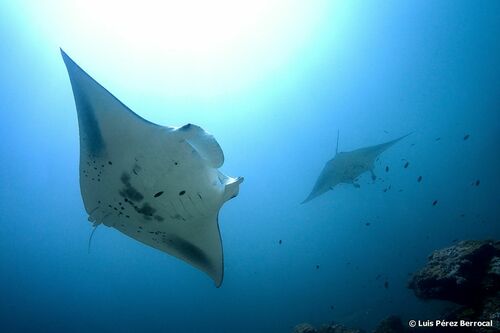
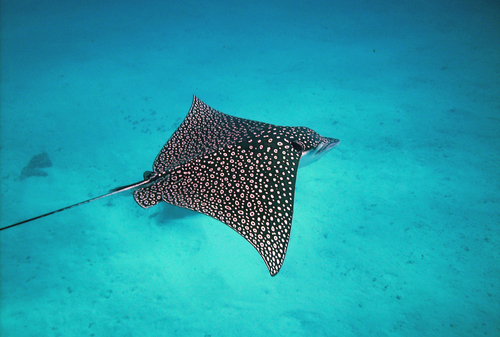
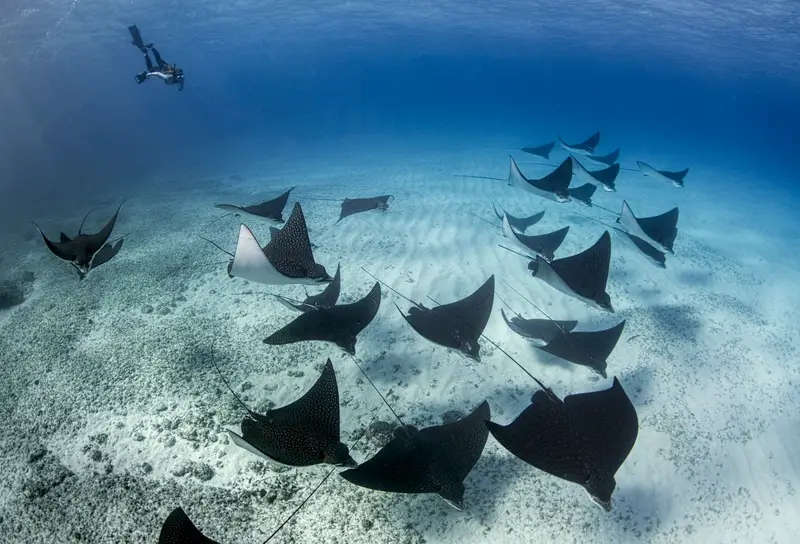
Manta Ridge in Yap (Micronesia) is the world's most reliable manta cleaning station — divers kneel at the bottom of a channel and watch mantas queue up. The rest of Yap's diving is reef and channel work, traditional and uncrowded.
Good season
Year-round; December–April is peak manta season (mating). November–May has best viz.
Trip duration
5–7 nights at one of a few resorts.
Dive style
Channel diving with moderate current; bottom-kneeling at cleaning stations.
Dive level
Open Water for cleaning stations; Advanced for channel drifts.
Reef health
What you’ll actually findOne of the few reefs whose live coral has held up over the last decade. Plan with confidence.
Coral reef health
How is this calculated?Heat stress right now
Mild warmth. Worth watching — no bleaching yet.
NOAA Coral Reef Watch · updated May 2026 · 0 °C-week heat dose
What to expect on a dive
Yap's reefs have been remarkably stable. Manta cleaning stations operate year-round in clear oceanic water.
Sources, methodology, and the raw numbers
Raw observed numbers
- Coral cover: 44% (survey Sep 2024, Local Pacific reef survey)
- Bleached: 6%
- Recent mortality: 2%
- Western Pacific refugium — observed condition reflects the stable regional pattern.
Raw thermal numbers
- NOAA CRW alert level: Watch
- Degree Heating Weeks: 0 °C-wk
- SST anomaly: +0.3 °C
How we summarise this
Observed coral cover, bleaching, and mortality come from named in-situ surveys with a stated date and method — they describe one snapshot of one reef and do not extrapolate to neighbouring sites. Current thermal stress is satellite-derived from NOAA Coral Reef Watch at ~5 km resolution; it indicates risk, not observed coral damage. We deliberately separate observed condition, current thermal stress, and projection — and we never publish a projection without a documented model and uncertainty.
Sources
- International Coral Reef Initiative — ICRI Secretariat
- NOAA Coral Reef Watch — U.S. National Oceanic and Atmospheric Administration
- AIMS Long-Term Monitoring Program — Australian Institute of Marine Science
- Global Coral Reef Monitoring Network — GCRMN / ICRI
- Atlantic and Gulf Rapid Reef Assessment — AGRRA Program / Perry Institute for Marine Science
- NOAA National Coral Reef Monitoring Program — NOAA Coral Reef Conservation Program
- Reef Check — Reef Check Foundation
- NOAA CoastWatch / OceanWatch — NOAA NESDIS / STAR
- Allen Coral Atlas — Arizona State University Center for Global Discovery and Conservation Science
- Great Barrier Reef Marine Park Authority — Australian Government
- Reef Life Survey — Reef Life Survey Foundation
- NASA PO.DAAC — NASA Jet Propulsion Laboratory / Caltech
- Copernicus Marine Service — Mercator Ocean International for the European Union
- NASA Ocean Color (OB.DAAC) — NASA Goddard Space Flight Center / Ocean Biology Processing Group
- Argo float network — International Argo Program / UCSD
- CoralWatch — University of Queensland
- IMOS / AODN — Integrated Marine Observing System / Australian Ocean Data Network
- WRI Reefs at Risk Revisited — World Resources Institute
- Ocean Health Index — OHI partnership (Conservation International + UCSB + NCEAS)
- IPCC Special Report on the Ocean and Cryosphere (SROCC) — Intergovernmental Panel on Climate Change
- GOA-ON — Global Ocean Acidification Observing Network — GOA-ON Secretariat + IOC-UNESCO
- HAEDAT — Harmful Algae Event Database — IOC-UNESCO Intergovernmental Panel on Harmful Algal Blooms
- NCEI Marine Microplastics — NOAA National Centers for Environmental Information
Reef condition changes year to year. If you visit, consider supporting responsible-travel and conservation operators on the ground.
Pressure on this reef
Protection · fishing · what you can doProtected-area status
Multi-use MPAInside a designated MPA that permits regulated fishing and other uses. Worth checking which zones at this location are no-take.
Fishing pressure
Moderate fishing pressureDominant pressures
- industrial fishing on EEZ edges
- warming
1 Green Fins-verified operator known at this location.
What you can do
Yap reefs are protected under traditional landowner control. Yap, Chuuk, and FSM mix traditional tenure with national park designations. Chuuk wrecks are legally protected as cultural heritage.
Protection status sourced from Protected Planet / WDPA and refined with Marine Protection Atlas. Fishing pressure proxy is Global Fishing Watch AIS data. See the methodology for what these sources can and can’t prove.
Dive sites here
2 curated
Mil Channel
Tidal channel where reef mantas come in to feed and be cleaned. On incoming tide, dozens stack up at the cleaning stations. The channel runs…
Valley of the Rays
Wide sandy channel where mantas congregate during mating season — trains of suitors follow females in long courtship displays. Mating bottom…
Gear
What to bringWhat divers say
“Sitting still on the sand while a manta hovers a meter above you for two minutes — Yap's signature moment.”