Planning a trip?
Hotels, dive operators, gear, and how to get here are on the Malapascua location page.
Overview
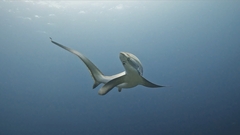
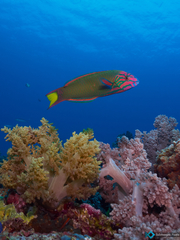
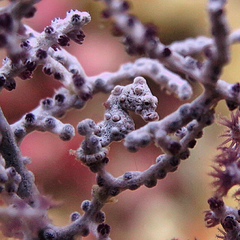
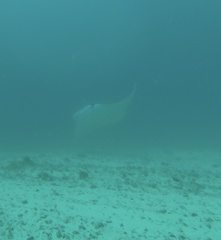
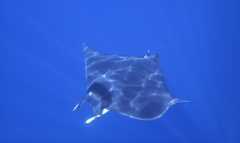
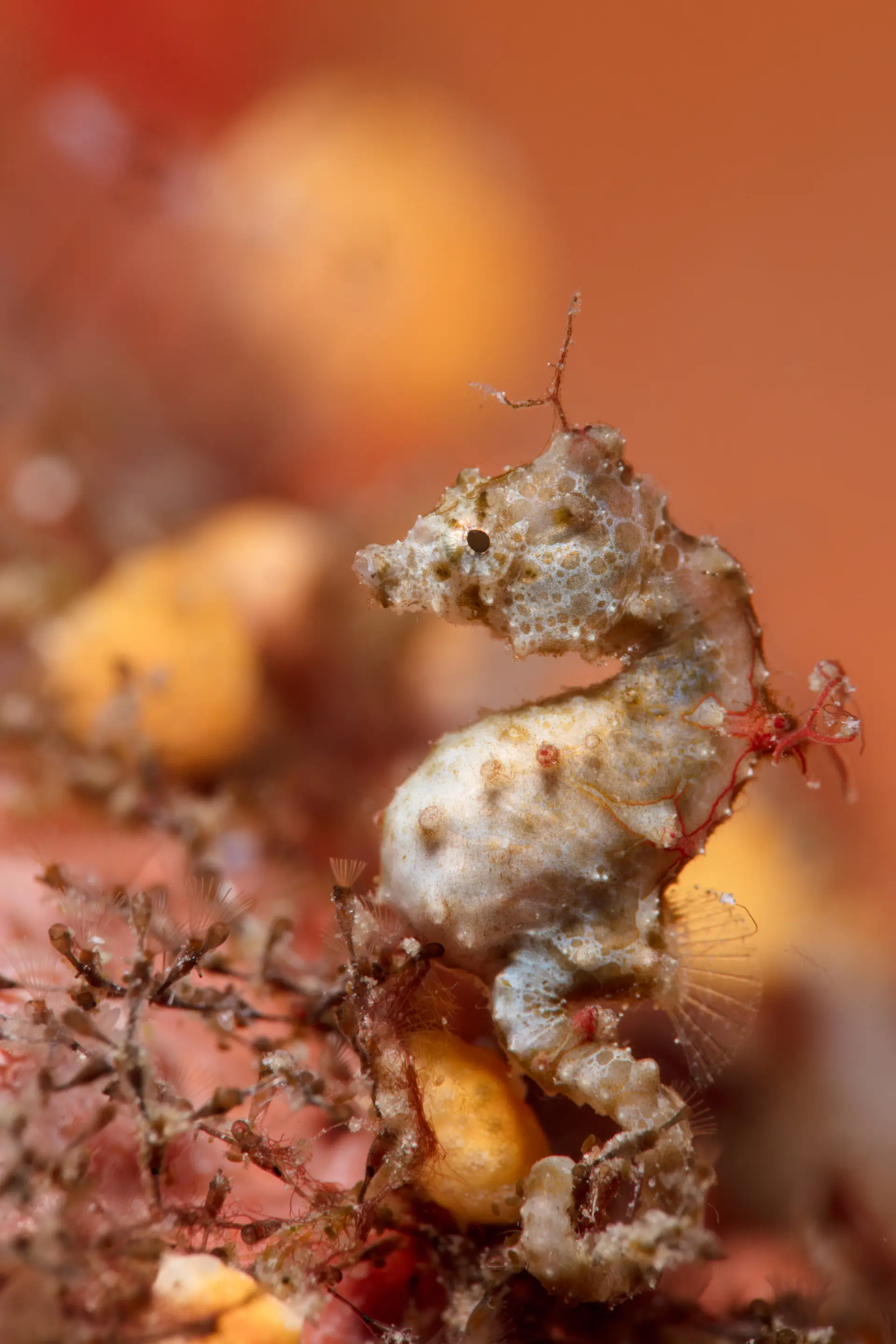
A submerged seamount about 8 km east of Malapascua that rises from 200 m to a flat coral plateau topping out around 16 m, and the only site in the world where pelagic thresher sharks (Alopias pelagicus) reliably appear at cleaning stations almost every dawn. Divers descend before sunrise to roughly 22–28 m and wait behind a designated rope line at the plateau edge while the threshers — with their elongated upper tail lobes nearly as long as their bodies — circle in to be cleaned by moon wrasses and cleaner shrimp. Devil rays and reef mantas also pass through; pygmy seahorses cling to gorgonians on the slope. Currents can run hard along the drop-off into deep water on three sides.
Briefing note
Pre-dawn departure is required — thresher sharks visit cleaning stations only at first light and disappear back to deep water by mid-morning. The Department of Tourism enforces a fixed mooring rope and a no-cross line on the plateau edge; touching, chasing or flashing strobes at the sharks is prohibited and rangers fine offenders. Most operators require AOW certification due to the 25–30 m hang depth and occasional strong currents along the wall. Typhoon season (Jun–Nov) can cancel boats; avoid the immediate aftermath of named storms. Nearest recompression chamber is in Cebu City.
What you'll see
6 species curated- year-roundPelagic thresher shark
- seasonalReef manta rayPeak: Dec · Jan · Feb · Mar · Apr · May
- seasonalDevil rayPeak: Dec · Jan · Feb · Mar · Apr · May
- year-roundMoon wrasse (cleaner)
- year-roundPygmy seahorse
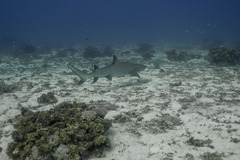
- year-roundWhitetip reef shark
Sightings evidence
1 record on file- high confidencePelagic thresher shark
- Last confirmed
- May 2026
- Recent records
- 287 within 5 km
- Cluster months
- Year-round
Pre-dawn cleaning ascents are reliable year-round when sea state allows.
Sources & methodology
How we summarise this
We aggregate confirmed occurrence records from GBIF and OBIS within a fixed radius of each dive site. Occurrence records confirm presence and reveal seasonality clustering, but they DO NOT measure per-dive probability — there is no eligible-effort denominator. We deliberately do not publish a numeric '% chance of sighting' from this data.
Sources
- Global Biodiversity Information Facility — GBIF Secretariat
- Ocean Biodiversity Information System — IOC-UNESCO
- OBIS-SEAMAP — Duke University Marine Geospatial Ecology Lab / OBIS
- iNaturalist — California Academy of Sciences & National Geographic Society
- IUCN Red List of Threatened Species — International Union for Conservation of Nature
- WoRMS — World Register of Marine Species — Flanders Marine Institute (VLIZ)
- FishBase — FishBase Consortium
- Atlas of Living Australia — CSIRO / GBIF Australia
- REEF Volunteer Fish Survey — Reef Environmental Education Foundation
Conditions
| Month | Water | Visibility | Current |
|---|---|---|---|
| Jan | 26–28 °C | 15–25 m | moderate |
| Feb | 26–28 °C | 15–30 m | moderate |
| Mar | 27–29 °C | 20–30 m | moderate |
| Apr | 28–30 °C | 20–30 m | mild |
| May | 28–30 °C | 15–25 m | mild |
| Jun | 28–30 °C | 10–20 m | moderate |
| Jul | 28–30 °C | 10–20 m | moderate |
| Aug | 28–30 °C | 10–20 m | moderate |
| Sep | 28–30 °C | 10–20 m | moderate |
| Oct | 27–29 °C | 10–20 m | moderate |
| Nov | 27–29 °C | 15–25 m | moderate |
| Dec | 26–28 °C | 15–25 m | moderate |
Season calendar
Peak season highlighted · current month outlined
Next step
Book your trip to Malapascua
Hotels, liveaboards, dive operators, gear recommendations, and travel logistics for the whole region.
Plan your trip →Some links earn us a commission. Learn more